Friday, September 6, 2019

Lafayette via Skook: 9/5/19


What better place to be on a day of 100-mile visibility? Especially via Skookumchuck Trail, the quiet and scenic northern approach.

The first mile of Skookumchuck Trail is an easy traverse through fine hardwood forest.


Then the trail meanders up along mossy Skookumchuck Brook.


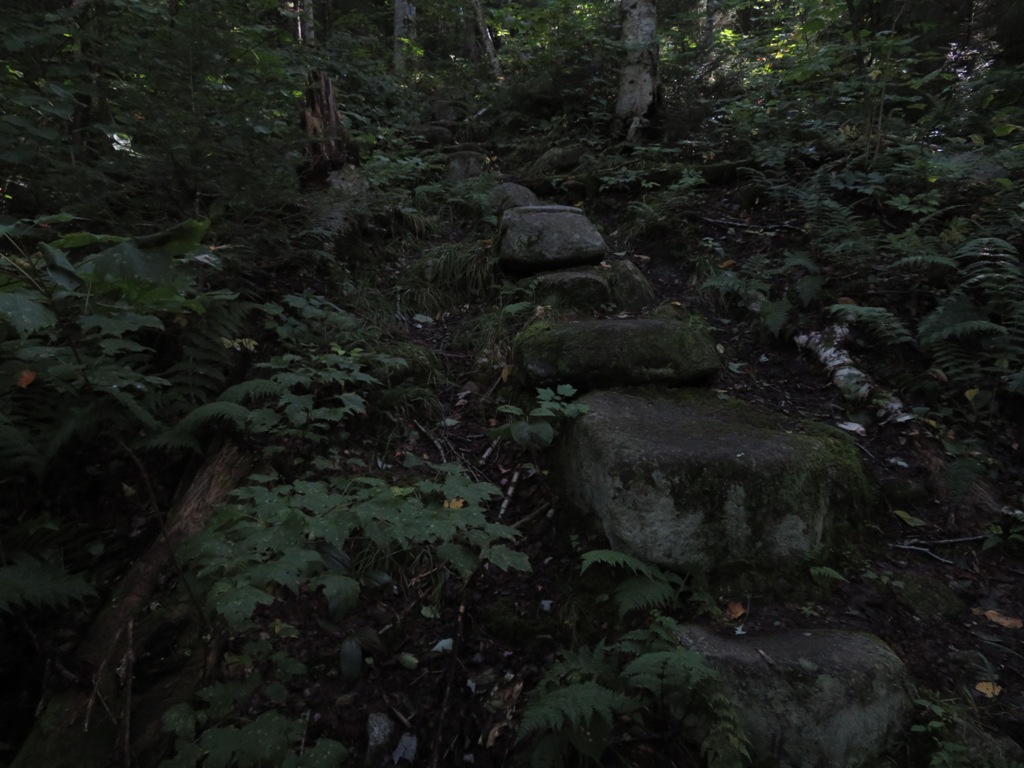
A steep rock staircase lifts you out of the valley.


Birches!


Ascending to the crest of the northern ridge, the trail passes through an amazingly open "salt and pepper" forest of birch and fir - a bushwhacker's dream.


Cozy forest higher up on the ridge.


Fir wave at 4100 ft.


A glimpse of Lafayette's North Peak ahead.


Gorgeous fir woods on a high shoulder. Skookumchuck has some of the nicest woods of any trail approaching a 4000-footer.


#4 is interesting.


Thankfully, most people pay attention to this.


A tricky ledge; there is a rough bypass to the right.


Yup, it's going to be a good view day.


Junction on the ridge.


About 50 yards to the east, trailside ledges offer stellar views into the western Pemi Wilderness.


Many peaks seen beyond Owl's Head to the south.


NoBo thru-hiker.


Heading up towards North Peak.


Looking back.


Many neat rock formations.


Looking down the Skookumchuck Trail's ridge.


Centered cairn.


Jumble o' rock.


Alpine scene.


North Peak looms ahead.


The flat top of North Peak, a fine viewpoint in its own right.


The bumpy north ridge leads up to the main summit of Lafayette.


Cannon/Kinsmans/Moosilauke.


Two lakes and two huts: Eagle Lake/Greenleaf Hut and Lonesome Lake/Hut.


The northern version of the Franconia Ridge skywalk.


Looking back at North Peak.


Continuous Pemi views.


Peering down into the Lafayette Brook ravine.


Cairns on the skyline.


Approaching the summit.


A busy place, even midweek in September.


These trail signs are critical in the fog.


Foundation of a summit refuge building constructed in the 1850s.


Summit benchmark.


Classic angle looking south down Franconia Ridge. From the summit it was a four state day: 4000-footers visible in NH (38), Maine (8), VT (all 5) and NY (Macomb).


he "sunless gorge" on the west ridge of Mt. Lincoln descended by AMC explorer Charles E. Fay and companion in 1880.


Hikers trooping up the ridge. Note the long east ridge of Mt. Flume in the background, dropping into the Pemi. Osceolas, Sandwich Dome and Tecumseh in the distance.


Scar Ridge and its slides, where I've been poking around recently.


Mt. Guyot and the Bonds.


By this point the summit was getting rather cacophonous with several groups.


Heading back along the quiet north ridge.


Col vista.


Looking back.


Heading down.


Last look into the Pemi.


Wednesday, September 4, 2019

Windows to the Wild in Waterville: 9/3/19


I had the pleasure of joining Willem Lange, host for the popular "Windows to the Wild" program on NHPBS, plus a quartet of Waterville Valley hikers and a film crew of three, for a leisurely hike to the Waterville Cascades. The program, focused on the hiking trails and history of Waterville Valley, is slated to run in early November.

Willem and his companion Kiki get a ride to a point partway up the trail from Brooke Wakefield, Recreation Director for the town of Waterville Valley. Brooke oversees an active hiking program in the Valley, and has created a "Waterville Valley Redliner 125" patch, earned by hiking 125 miles of trails in and around Waterville.


Phil Vaughn and Steve Giordani, Producers for Windows to the Wild, set up a shot of Mt. Osceola as Waterville hikers and historians Preston and Brenda Conklin look on.


Brenda and Preston Conklin walk the Cascade Path en route to the Waterville Cascades. This path is one of the original Waterville trails opened in the 1850s by innkeeper Nathaniel Greeley. Though there are older individual trails, such as the Crawford Path, Waterville Valley is home to the oldest trail system in America. The Cascade Path is currently maintained in fine shape by the Waterville Valley Athletic & Improvement Association (WVAIA), which was founded in 1888.


Willem, Kiki, Phil and Steve make way for a pair of passing hikers.


Steve, Willem and Phil at work on the program.


Willem makes his way up a beautiful stretch of the Cascade Path.


Admiring the view of the first waterfall, once known as Greeleys Cascade.


The cascades were in good flow after nearly two inches of rain the previous day.


Willem navigates a steep, rooty stretch of trail. A lifelong outdoor adventurer and still getting out there at age 84, he is an inspiration to many. And Willem is a delightful trail companion, with many a fascinating and funny tale to tell.


Willem chats with Dan Newton, President of WVAIA and an avid Waterville explorer and trail maintainer. As a local expert, Dan leads guided hikes year-round for the Waterville Valley Recreation Department.


Another of the six or seven (depending on how you count them) cascades seen along the Cascade Path.


Brooke, Willem, Dan, Brenda and Preston gather on the bridge at the top of the trail as Dan's companion Friday chills out.


Preston and Brenda get a lift in the back of Dan's pickup.


After returning from the Cascades, we headed a few miles down Rt. 49 for a short history hike on the Old Waterville Road, the original route leading up the Mad River valley. Here Preston outlines the story of the beautifully preserved Samuel Dolloff cellar hole. Samuel Dolloff and his family lived here from the 1850s to the 1890s. Four of his sons fought in the Civil War and survived. Samuel served as Waterville Valley selectman for a quarter century. In 1870 his 100-acre farm was valued at $800.


The Old Waterville Cemetery is located farther up the Old Waterville Road. The plot was purchased by the Waterville selectmen in 1831 for $2.11. Francis D. Foss was most likely the son of Moses Foss, the first settler in Waterville, who homesteaded near here in 1819. These are among many fascinating stories revealed by the Conklins' meticulous historical research.


The Old Waterville Cemetery is located farther up the Old Waterville Road. The plot was purchased by the Waterville selectmen in 1831 for $2.11. Francis D. Foss was most likely the son of Moses Foss, the first settler in Waterville, who homesteaded near here in 1819. These are among many fascinating stories revealed by the Conklins' meticulous historical research.