

The next 0.9 mile is rather a slog along an old logging road, with nine (I counted) drainage dips to step or jump across.

A solid snow bridge over the brook that drains eastward from Bunnell Notch, the pass between Mount Cabot and Terrace Mountain.

After the trail climbs away from the logging road and meanders across a plateau, it drops down to the Bunnell Notch brook and follows alongside it, with a few more of those pesky drainage dips and divots, which become annoying when the snow is deep.

And the snow is indeed deep, as evidenced by this trench.

Shadows deep in the valley.

Heading up the slope through sunny hardwoods.

Tunneling into Bunnell Notch.


Junction with Kilkenny Ridge Trail in the notch.

A snow-laden duck-under.

Some old tracks coming up the Mount Cabot Trail, which has been closed since 2000 due to a landowner dispute with the Forest Service. This was the route usually used to climb Cabot before the closure as it was a shorter drive and shorter hike than the Bunnell Notch route.

Here the Kilkenny Ridge Trail joins the route of the old horse trail serving the fire tower that stood up on the Cabot summit ridge starting in 1911. (The fire tower was dynamited in 1965 as a training operation for U.S. Army Special Forces.) This section of trail climbs by long, steady grades with several sharp turns.

As I was approaching the viewpoint at Bunnell Rock, I stopped for a chat with Emily and Kurt, who were on their way down (having covered six miles to my not quite four miles). They told me that Peter Crane, a longtime friend, was up behind them and on his way down.

I soon took the short side path out to Bunnell Rock, a wonderful sun-drenched, south-facing perch.

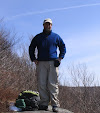
I was quickly joined by a local resident.


In a few minutes Peter emerged from the trees, and we had a good visit. Having completed the Grid back in 2009, and finishing his 48 Over 70 last year (I ran into him on Waumbek two winters ago when he was starting on that project), he is now working on his Winter 48 over 70. Cabot was #27. Peter has been a quiet steward of the mountains and contributor to the hiking community for many years. After working for the Forest Service and AMC, he has been with the Mount Washington Observatory since 1988 and presently serves as Curator of the MWO's Gladys Brooks Memorial Library. He was also a longtime volunteer with Androscoggin Valley Search & Rescue and was for many years on the board of the NH Outdoor Council. He continues to maintain the Raymond Path on Mount Washington. Peter is also a noted White Mountain historian and wrote his doctoral thesis on the logging village of Livermore (which can be viewed on the website of the Bartlett Historical Society: https://www.bartletthistory.net/livermore-peter-crane).


There is an abundance of snow up here!

Per usual in a deep snow winter, there's a lot of ducking under overhanging branches on the upper ridges. I was thankful that the hikers who preceded me had knocked much of the snow off.

One of the reasons we hike in winter - sculptured firs against an electric blue sky.

Emerging on the plateau of Cabot's south summit.

The fire warden's cabin, still available for public use.

Trees are obscuring the former westerly view from the porch of the cabin.

Many years ago some friends and I spent a 15 below zero December night in here. We were expecting to use a wood stove, but it hadn't yet been set up for the winter. Twas a long and miserable night. Our boots were frozen ice chunks in the morning. It was the only time I've used a potholder to pull them on. That experience cured me of any further desire to camp in winter. The stove was removed for good a few years after our stay for safety reasons.

The views from the fire tower site just above the cabin have become more and more restricted over the years. Deep snow improves them markedly. This vista looks out to vast western horizons.

East to the long chain of the Mahoosucs.

Snow-capped Old Speck (center) and Baldpate (left).


Drift.

The hikers before me had done a great job of following the meandering trail through the deep snow and heavily laden trees.

Time to duck.

An early winter ascent of Cabot was made by an AMC group of four in 1906. At the top they found the “mountain-top forest, all deep-muffled in untrodden snow” and savored “the absolute stillness of perfect winter.” An account by Raymond M. Dow Adams, “Pilot Dome in Winter,” was published in the May 1906 issue of Appalachia.

The blazes are sinking.

The near-summit sign where the Kilkenny Ridge Trail turns right for The Bulge and The Horn.

The actual high point is 30 yards farther ahead, to the NW.

Wonder when this section of trail will get broken out.

Peek-a-boo view on the way back to the fire tower site.

A preview of sunset color to the west.

The Killington Range on the horizon.

High peaks in the Rangeley area: Bigelow Range on the left, Crockers in the center, and snowy Saddleback and The Horn on the right.

Beautiful open fir glade on the south peak.

Sunset coming on at Bunnell Rock.

Slightly zoomed.

Cold light on Waumbek and Starr King behind North Terrace. The Twins peek over the col to the right of Starr King.

Lafayette and Lincoln rising behind Garfield.

Cannon/Kinsmans/Moosilauke with Mount Clough to the R.

Sunset through the trees.

In the Kilkenny by headlamp. It was a late exit but a great day.


No comments:
Post a Comment