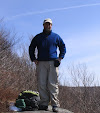
The Benton Trail on the NW side of Mount Moosilauke is one of my favorites, and several times over the years I've used it as the access to explore some of the many "fir waves" at the edge of the ridgecrest to the west. Fir waves, which are bands of dead and dying trees that slowly migrate across a slope, are one of the most interesting natural features in the
Whites. Presumably caused by icing and other stresses of life at high elevation, these are seen as a series of wavy gray bands high on a darkly wooded mountainside. They can be prickly to navigate, but due to their openness, fir waves can provide good views, sometimes from unusual angles. Several of Moosilauke's ridges are striped with fir waves.
After a 1.5 mile walk up the road portion of Tunnel Brook Trail, I turned onto Benton Trail and made an easy low-water crossing of Tunnel Brook.

Hardwoods rule along the first 3/4 mile of Benton Trail.

Through the conifers to the outlook above Little Tunnel Ravine.

The most open view here is north beyond a spur ridge of Mount Blue to the Kinsmans.

It is a nice profile of the Kinsmans, with the little bump of Bald Peak seen left of center. Mount Cabot is faintly seen on the hazy horizon.

The view into Little Tunnel Ravine has become more obstructed in recent years, but this is still a neat wild spot, with the muted roar of the cascades on Little Tunnel Brook wafting up from below. I spent an hour relaxing here, chatting at one point with an AMC Boston Chapter group hike.

This big slab appears to be part of an old slide that fell into the ravine.

Though it has become more eroded over the years, some sections of Benton Trail still have wonderful footing. It is admirably maintained by adopter Per Frost.

Into the boreal forest.

I left the trail at ~3600 ft. and headed west through mostly open woods, though there were some rougher spots, too.

After a half hour or so I emerged in an open fir wave that I had visited last year, with a distant view to the west.

Black Mountain and Sugarloaf in the Benton Range were visible in the foreground, with Vermont's Signal Mountain Range in the middle distance. The distant Green Mountains were dimly visible though the haze.

I followed a moose path down through the brushy opening to access another fir wave below.

Looking back up.

A lovely fern-filled glade between the fir waves.

Another opening in sight ahead.

A nice view south from this fir wave.

Mount Clough and its slides falling into Tunnel Brook Notch are seen in the foreground. In the distance are Mount Cube, Mount Mist, Webster Slide Mountain and Piermont Mountain.

The inside of a fir wave. As the older trees die back, vigorous new growth springs up.

Adding Smarts Mountain to the view.

The view I was seeking the most was a clear look at the massive 2011 slide in Tunnel Ravine, courtesy of Tropical Storm Irene. Found it!

Zoom on the upper part of the slide....

...and the lower part, where revegetation by birches is well underway.

A peek at the steep headwall of Tunnel Ravine, one of the wildest places on Moosilauke.

Heading back through the ferns.

Homeward bound on Benton Trail.


